
The Apollo program was the NASA ( National Aeronautics and Space Administration ) program that resulted in a series of American spaceflights, with Apollo as the spacecraft and Saturn IB and Saturn V as launch vehicles.
Rockets
The Apollo program uses two different types of rockets. During the first flights, the smaller Saturn One B rocket was used. It was built in two parts, a total of about 68 meters high and 6.6 meters in diameter. When the fuel ran out in the first part, it was released from the second part and burned up in the earth’s atmosphere. The second part continued the journey. The Saturn I (one) B rocket was used to test the new Apollo capsule in the Earth’s orbit. For the other flights, the more powerful Saturn V (5) rocket was used. It was a three-stage rocket capable of sending Apollo to the moon. It was 110.6 meters high and had a diameter of 10 meters.
Saturn 1 B
Saturn 1 B had 9 launches, all were successful. Their maiden voyage took place on February 26, 1966. The last voyage took place on 15 July 1975.
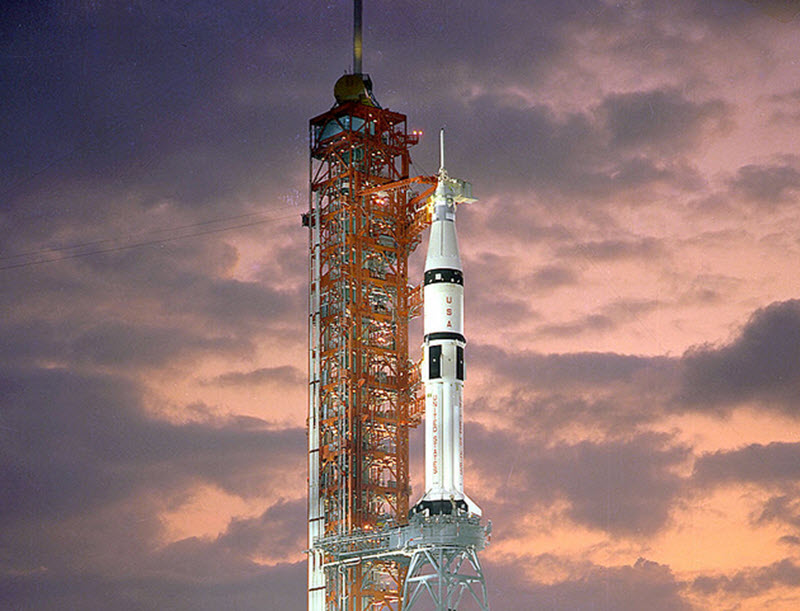
- The first stage, S 1B, had 8x H-1 engines. The thrust was 6.7 MN. Burning time was 150 seconds. The fuel consisted of RP-1 rocket fuel/liquid oxygen.
- The second stage, S-IVB, had 1x J-2 engines. The thrust 890 kN. Burning time 475 seconds.The fuel consisted of liquid hydrogen/liquid oxygen.
Saturn V
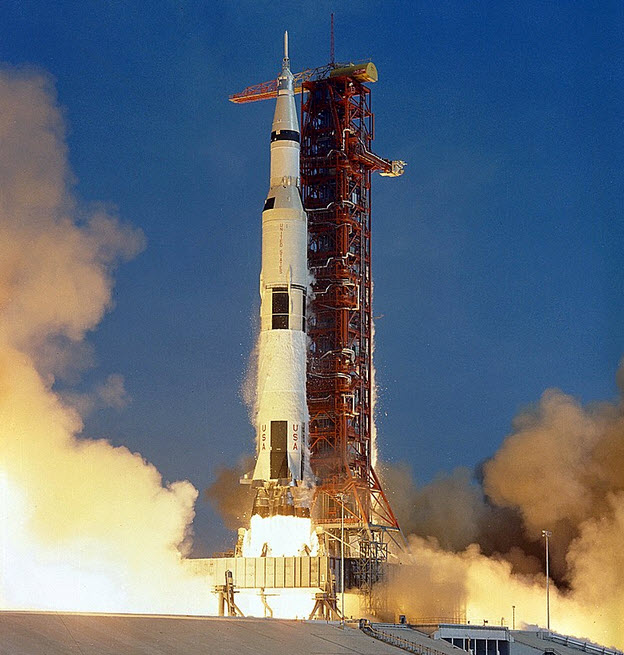
Saturn V was a further development of the earlier Saturn rockets. Saturn V, was built in three stages and was intended to be used only once. It was powered by liquid rocket fuel.
The Gemini and Mercury program
The Apollo program was the third US manned space program launched. Before Apollo, there were the Gemini and Mercury programs.
Mercury program
The Mercury program was NASA’s first manned space program. It was started in 1959 and lasted until 1963. During that time, 15 of a total of 20 capsules were sent into space, six of them were manned. They wanted to find out if humans could survive in space. There were very small capsules that were sent up, only 1.7 cubic meters and there was barely room to fit one person.
Gemini program
The Gemini program laid the foundations for the technology that would be needed to send man to the moon.
The God Apollo
The program was named after the god Apollo. Apollo was god of th sun, truth and prophecy.
The Apollo program
From the beginning, Apollo was intended to be a follow-up to the Mercury program with advanced missions in Earth’s orbit. The President of the United States at that time, John F. Kennedy, changed the direction of the project during a speech to the US Congress on May 25, 1961.
The Apollo program lasted between 1961 and 1972 and consisted of 17 space missions. The first Apollo mission exploded on the ground in 1967 and three astronauts lost their lives. After that, there were six unmanned test trips. The first four flights tested the equipment used in the Apollo program.
In 1968, Apollo 7 was manned, but it was Apollo 11 that made the moon landing on July 20, 1969. The Apollo 13 journey to the moon in April 1970 became dramatic. An oxygen tank exploded during the trip, which meant that they could not land on the moon according to their plans. Instead, the three astronauts had to fly back to Earth in the badly damaged capsule.
A famous movie has been made about the event that came out in 1995 with the same name as the spacecraft.
The last moon mission in the Apollo project was carried out by Apollo 17 in 1972. On the last three Apollo missions, astronauts drove a lunar rover on the moon.
Apollo Modules
NASA designed the Apollo Command Module for this program. It was a capsule where there was room for three astronauts. The astronauts rode in the command module on the journey to the moon and on the way back. It was larger than the spacecraft used in the earlier Mercury and Gemini space programs. There was room for the astronauts to move inside the spacecraft, about as much space as in a car.
In order to land on the moon, another spacecraft, the Lunar Module, was used. It was able to transport the astronauts from the moon’s orbit to the moon’s surface and then back to the Command Module. The Lunar Module had room for two astronauts. Astronauts Neil Armstrong and Buzz Aldrin landed their Apollo Lunar Module on the moon July 20, 1969, and walked on the moon, while Michael Collins remained in lunar orbit in the command and service module.
The Apollo mission’s goal was about more than just landing Americans on the moon and then bringing them home to Earth in good condition.
- They also wanted to establish the technology to meet other national interests in space.
- They wanted to achieve a prominent place in space for the United States.
- Another major goal was to implement a program for scientific exploration of the moon, as well as developing human ability to work in the moon’s environment.
Ideological motivation
The Apollo program and moon landing also had an ideological motivation. The USA wanted to show the USSR that the Capitalistic system was superior to the USSRs communistic planned economy. The Apollo program would likely have been lower priority if the Space race hadn’t been burning at that time.
In the end the free economy with all its stock market trading, traders, investors and entreprenuers ended up winning both the space race and the cold war. Russia ended up adopting a very unregulated capitalism that allowed the oligiarks to rise to power in much the same way as famous traders and robber barons such as Andrew Carnegie, John D. Rockefeller and J P Morgan that rose to power one hundred years earlier in the USA.
During all the successful moon landings, a total of 12 astronauts walked on the moon. Scientific research was conducted by the astronauts. They studied the surface of the moon and collected moonstones to bring back to Earth.
All manned missions
All eleven manned missions in the Apollo program were launched from the Kennedy Space Center in Florida.
- Apollo 1 – Three astronauts died in a fire during ongoing tests almost a month before the planned launch.
- Apollo 7 – It was the first manned launch. It was also the only manned Apollo flight that did not use the Saturn V rocket.
- Apollo 8 – It was the first manned flight around the moon.
- Apollo 9 – The first flight in the lunar module.
- Apollo 10 – The first flight around the moon in the lunar module.
- Apollo 11 – The first landing on the moon July 20, 1969.
- Apollo 12 – The first precise landing on the moon
- Apollo 13 – An oxygen tank exploded and made the planned moon landing impossible.
- Apollo 14 – The only astronaut from the Mercury program gets to walk on the moon, Alan Shepard.
- Apollo 15 – The first ride with the moon car.
- Apollo 16 – The first landing in a highland.
- Apollo 17 – The first scientist on the moon.